Your integrations are already built. There's nothing for you to build or maintain.
With your ATS and back office side by side, you can see which recruiter brings in the most margin, for example.
RecBi takes the figures from those systems and sets one definition of a placement.
 CarerixATSsource
 EasyFlexBack officesource
 AFASFinancesource
 Google AnalyticsWeb analyticssource
 OTYSATSsource
 RecruitNowATSsource
 BullhornATSsource
 MysolutionATSsource
 BynerATSsource
 HelloFlexBack officesource
 PivotonBack officesource
 TigrisATSsource
 TextkernelMatchingsource
We already connect these systems.
ATS and recruitment software
Staffing software, back office and finance
Marketing
We also read exports and databases. Tell us what you use and we'll tell you if it can be done.
How your systems come together in one dashboard.
Your whole agency works with the same up-to-date figures.
Collect
With integrations that have been running at other agencies for years.
Clean up and align
What one system calls a placement, another calls a contract. We define what counts.
Combine
Your figures are up to date in one dashboard.
Act
By branch or by channel, you see where things get stuck.
Questions you can only answer once your sources are connected.
You can't answer any of these questions with a single system.
Which channel leads to placements
Side by side, you see which channel brings in suitable candidates and which mostly brings volume.
Where your time to fill gets stuck
You see which step loses time, from screening call to first working day.
Who really made a placement
The back office puts a placement under one name. The ATS shows who else worked on it.
Questions agencies often ask.
Is this going to be an IT project?+
What happens to our data?+
Our data is a mess.+
Can we start without connecting anything?+
How does setting up an integration work?+
“This integration is really tricky for us.”+
See where you stand, without connecting anything first.
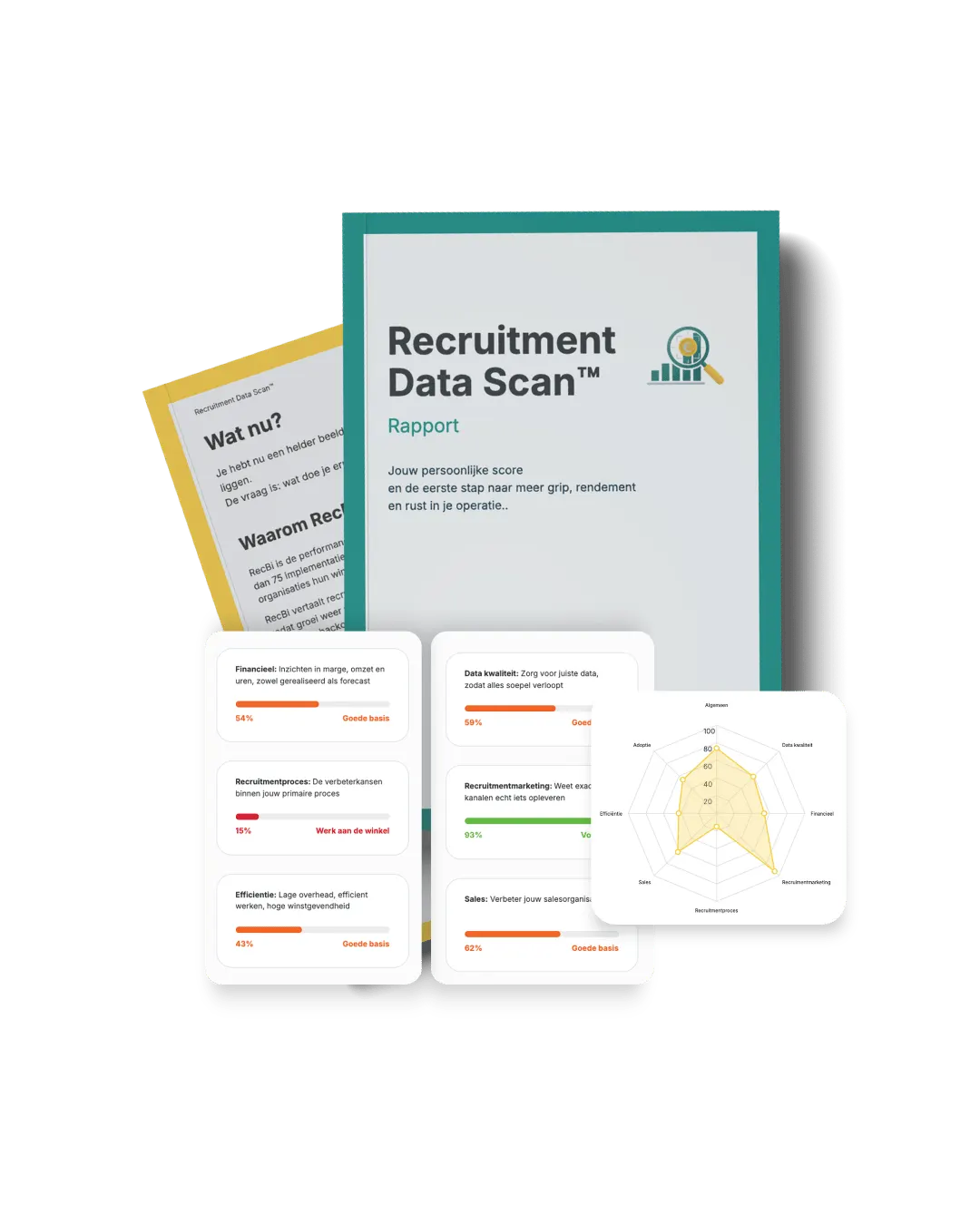
The Recruitment Data Scan uses what you fill in and public data, and shows where your agency is missing opportunities.